

Forklift in pedestrian zone
Detect a forklift entering an area reserved for pedestrians only.
The system detects a forklift in a pedestrian zone to reduce the risk of an accident
The "Forklift in Pedestrian Zone" scenario detects a forklift in an area designated for pedestrians only. The mixing of pedestrian and forklift traffic is one of the main causes of serious accidents in warehouses, which is why separating traffic zones is fundamental to safety management.
Automatic violation detection allows you to immediately identify a situation where a forklift is in a pedestrian zone and respond before a collision occurs.
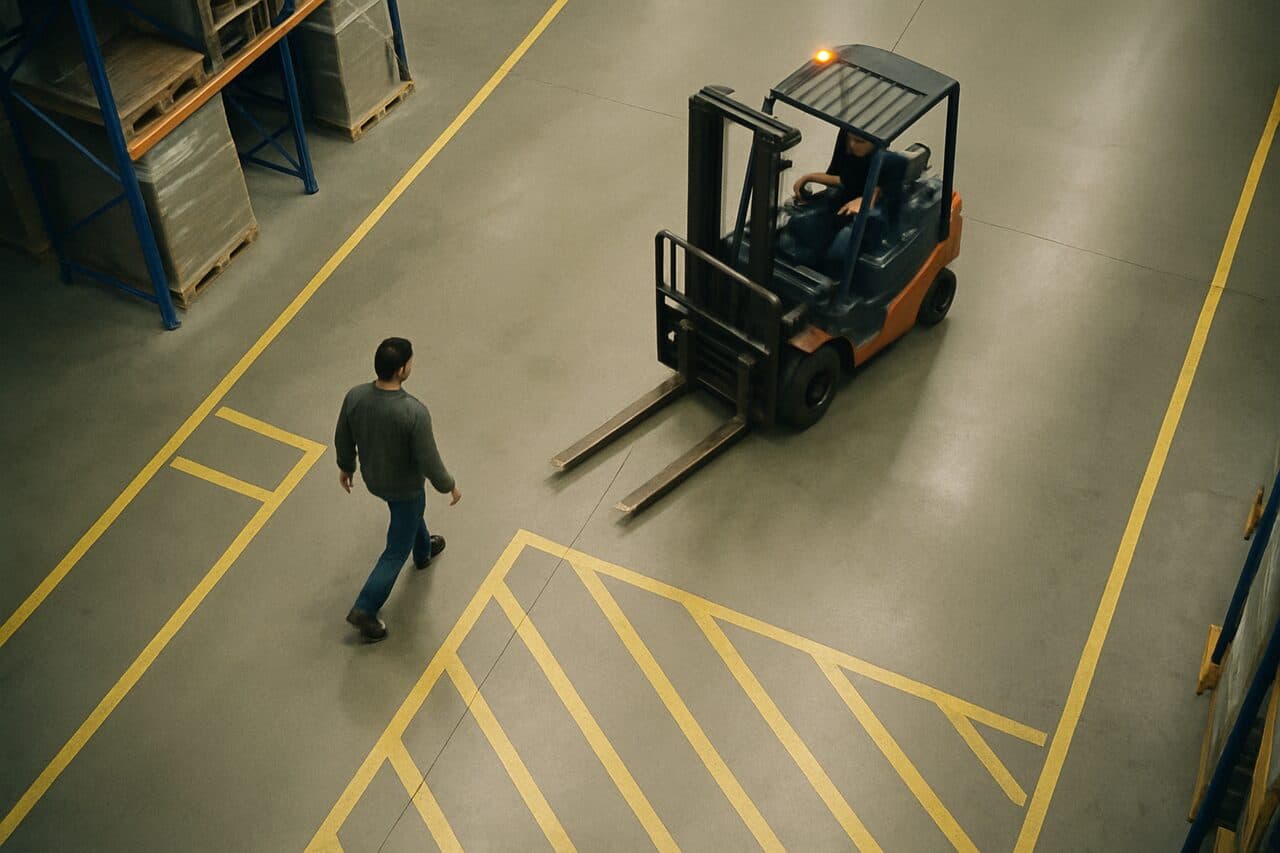
Reaction at the moment of the breach
A detection raises an alert and andon signal the instant a forklift appears in the pedestrian zone.
Configurable pedestrian zones
You define exactly which areas are reserved for pedestrians. Detection watches only where forklift traffic is forbidden.
Around-the-clock monitoring
Detection operates continuously 24/7, regardless of shifts, and without the risk that anything will escape the staff's attention.
How forklift-in-pedestrian-zone detection works
Industrial cameras monitor a designated zone, and video servers run the SAM3 detection model—configured to recognize forklifts in pedestrian zones—which operates locally on-site without transmitting data to external servers.
Each match becomes an event that integration gateways forward to AndonCloud and the machines’ PLCs.
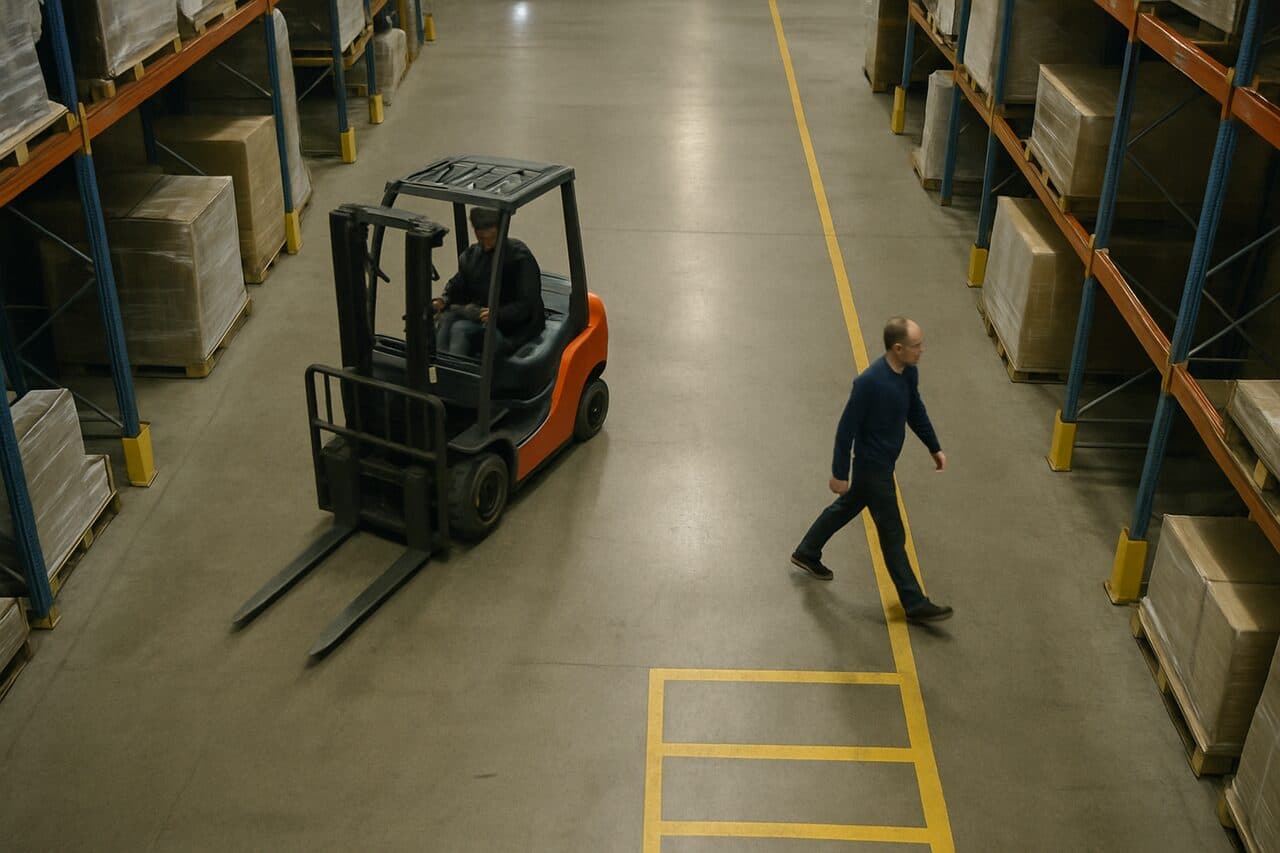
Detection at the edge
The model runs on a video server located on-site. This allows the system to respond immediately, without any delays caused by transmitting recordings off-site.
Andon & PLC integration
Upon detecting a cart in a pedestrian zone, the system can activate a light signal, send a notification to the dispatcher, or trigger a specific action on the machine's control unit.
No footage in the cloud
Only information about the incident is released to the public; camera footage is never released. The video data never leaves the facility.
Example use and privacy
At a designated crosswalk, the camera detects a forklift entering the area. The system immediately triggers an Andon signal and sends a notification to the dispatcher, while the incident itself is recorded in the health and safety report.
The system recognizes when a forklift is in the pedestrian zone, not the person operating it. There is no facial recognition or operator identification involved, as this is not necessary to detect the violation.
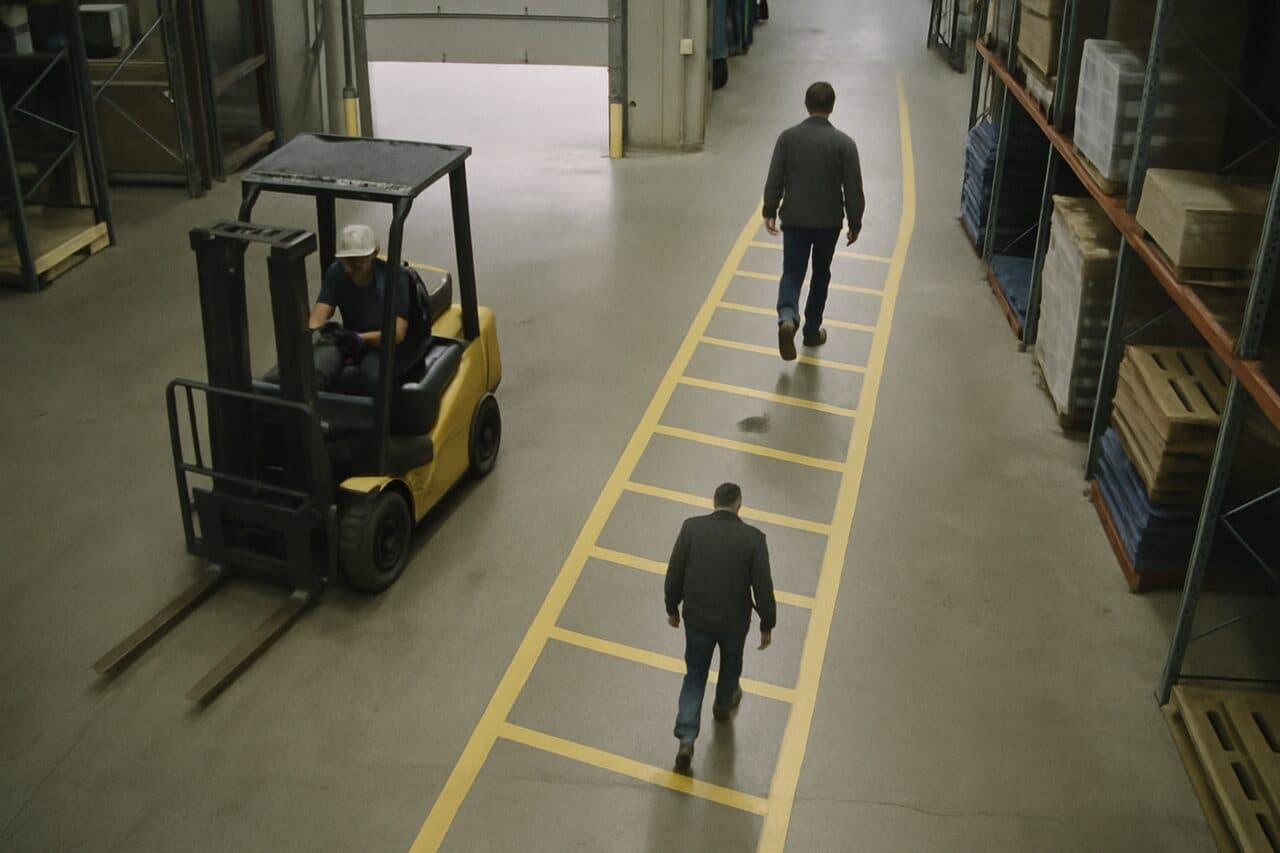
No personal identification
The system responds to the object and its location, not to personal information. The camera does not recognize faces and does not associate the event with a specific employee.
A full event trail
Each detection is recorded with the exact time and zone, making it possible to reconstruct what happened and when, for the purpose of investigating a specific incident.
Data for analyzing occupational safety and health trends
Recorded incidents can be analyzed over time to identify the zones where violations occur most frequently, which helps assess where the separation of pedestrian and cart traffic needs to be strengthened.
System
Our system is intuitive, but you can always count on us
We help your team work more efficiently every day.
Documentation
Customer support
Integrations
FAQ
Frequently asked questions
- The presence of a forklift in an area reserved for pedestrians only. The system recognises the "forklift in pedestrian zone" state, not the operator's identity.
No. Detection is about a state and an object — there is no biometric identification or face recognition.
- Yes. Detection areas are configurable, so the system reacts only where forklift traffic is forbidden.
- The event triggers an alert, an andon signal, a dashboard entry and a report line; it can also trigger an action on a machine controller.
Yes. The system operates locally on a video server located on-site, so it responds immediately when a forklift enters the pedestrian zone, without any delays caused by transmitting footage off-site.
- Standard industrial IP cameras watching the zone; the image is analysed locally by the vision server.
No. Image analysis takes place locally, on the facility’s video server. Only information about a detected event is sent externally; never the camera image or video stream.
Yes. Integration gateways link events to AndonCloud and PLC controllers — for example a light signal or a dispatcher notification.
The "Forklift in pedestrian zone" scenario detects a forklift in an area reserved for pedestrians only. Mixing foot traffic with forklift traffic is one of the leading causes of serious warehouse accidents, which is why separating zones is a cornerstone of safety planning. Automatic detection lets you catch a breach of that rule the moment it happens.
In the AndonCloud computer-vision pipeline, industrial cameras watch the designated zone while vision servers run the SAM3 detection model with the prompt "forklift in pedestrian zone" at the edge. Every match becomes an event that integration gateways forward to AndonCloud and machine PLCs — as an alert, an andon signal, a dashboard entry and a line in a report.
For example, on a walkway reserved for staff the camera spots an incoming forklift and triggers an andon signal and a notification for the dispatcher. The system recognises the "forklift in pedestrian zone" state, not the operator's identity — it performs no biometric identification or face recognition.
Contact
Contact us
If you have any questions, talk to our expert
We will respond within the next business day
sales@andoncloud.comPhone
Monday - Friday; 9:00 - 17:00
+48 71 340 70 15
Marcin Wierzbicki
During the meeting, we will present the product and help you configure the system in your company efficiently and quickly. Our team is at your disposal.
Newsletter
Sign up for the newsletter
Want to stay up to date? Sign up for our database.
By subscribing to our newsletter, you agree to our Privacy Policy and to receive updates from our company.